Why Unions Still Matter: Lessons from Samsung’s $26 Billion Deal

Updated: Sep 8
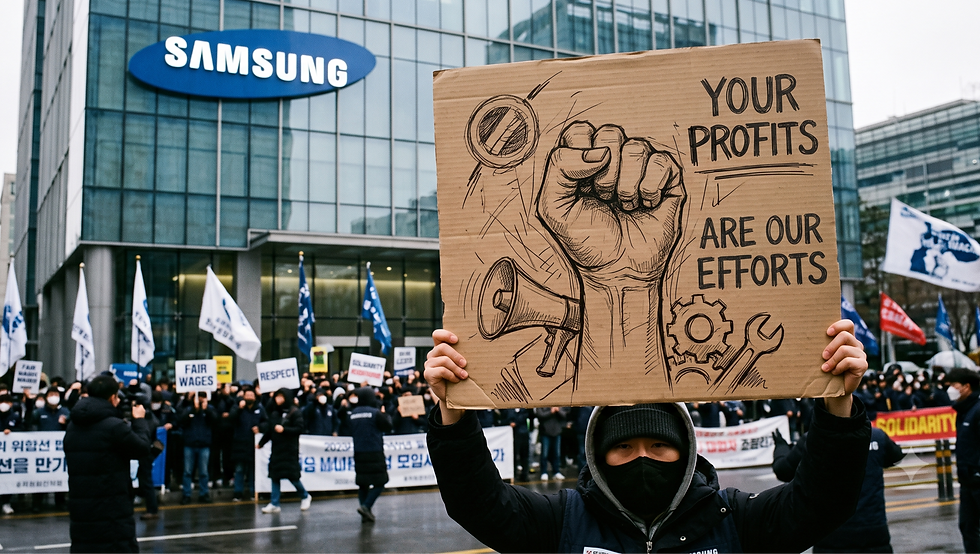
In late May 2026, workers at Samsung Electronics pulled off something massive. They pressured management into signing off on an uncapped profit-sharing model, potentially landing employees in the semiconductor division an average bonus of nearly $400,000 (roughly 600 million won).
The deal came after weeks of intense negotiations between the union and Samsung leadership. It was a calculated move at the bargaining table, timed precisely to hit a global tech choke point. What the National Samsung Electronics Union managed to pull off won't just change how Samsung runs its business. It is going to send shockwaves through the rest of the semiconductor and memory manufacturing market.
The Blueprint of a $400,000 Windfall
Ratified on May 27, 2026, with a 74% majority, the agreement ties labor compensation directly to the massive cash flows of the AI boom. Under the new terms, Samsung will set aside 10.5% of its semiconductor operating profit for a special employee bonus pool. With brokerages projecting those profits to clear 32.7 trillion won (around $22.6 billion) this year, the payout reality for the staff is massive.
The pool splits along operational lines. Forty percent gets distributed equally across all semiconductor units, including memory, design, and foundry. The remaining 60% scales based on how individual teams perform. For an average memory engineer making a 100-million-won base salary, this structure paves the way for a 550-million-won performance bonus. Combined with regular incentives, total annual pay hits that historic $400,000 milestone.
To keep its cash reserves from taking a sudden hit, Samsung is avoiding a single lump-sum payout. Instead, the bonuses will vest as treasury stock over three years, with one-third becoming cash-convertible annually. This keeps the company liquid while keeping workers tied directly to Samsung's stock performance.
Exploiting the Macro Choke Point
The National Samsung Electronics Union (NSEU) timed its strike perfectly, hitting right as tech giants were fighting tooth and nail over High-Bandwidth Memory (HBM) and advanced DRAM to fuel new AI data centers. Because these cloud clients lock in long-term supply agreements, any break in Samsung’s delivery pipeline could have triggered severe financial penalties and sent clients straight to Micron or SK Hynix.
The union knew that Samsung’s reputation for operational reliability was its biggest leverage point. By threatening a walkout right at peak demand, they turned the corporate calendar into a weapon.
Samsung's Multi-Billion Dollar Clock
A fab is a continuous-flow environment. Silicon wafers pass through thousands of chemical and lithographic cycles that require flawless continuity. You cannot turn these plants off and on like a light switch. Stopping production mid-cycle spoils billions of dollars in active wafers and delicate chemical solutions. Resetting the machinery, purging contaminated environments, and recalibrating extreme ultraviolet (EUV) systems can take weeks.
The industrial math was brutal:
Revenue losses: Estimated at $30 million every single day.
Profit impact: JPMorgan projected total operational disruptions could wipe out between $14 billion and $20.79 billion from the bottom line.
Samsung management folded as they faced a strike that could destroy its entire production pipeline and delivery targets. The company agreed to the 10.5% revenue-sharing
agreement just hours before the May 21, 2026, deadline, following frantic government-mediated sessions; they signed the deal.
The Takeaway
An individual engineer cannot threaten the continuity of a multi-billion-dollar fab or rewrite executive compensation policy. Unions matter because they take individual vulnerability and turn it into institutional force. By moving together and forcing leadership to look at the cold economics of a dead factory floor, Samsung's workforce proved that if you build the future with your hands, you have the leverage to demand a real piece of it.
The fallout from this deal isn't going to stay contained to South Korea. By anchoring labor payouts directly to the wild profitability of the AI boom, Samsung's union just handed a playbook to tech workers everywhere. Competitors like Micron, SK Hynix, and Intel are suddenly sitting on a volatile workforce. Even TSMC, which historically hasn't had to worry much about organized labor disruptions in Taiwan, will likely see its engineering teams look at this $400,000 milestone and start rethinking their own leverage. Samsung just showed the entire semiconductor industry what happens when the people running the cleanrooms realize they hold all the cards.

Comments