The Price of "Liberation": Who Actually Pays When the Statues Fall?

There is a specific kind of confidence that only arrives wrapped in the language of rescue. It shows up with high-def press conferences, "precision" bombs, and a moral clarity about which tyrants have to go.
Then, once the statue is pulled down and the cameras move on, that confidence disappears. What stays behind the broken states, the millions of refugees, the kids growing up in "temporary" camps they’ll never actually leave, rarely makes the evening news.
The Cycle We Can't Seem to Break
Since 2001, almost every externally driven regime change hasn't brought stability. It has brought the opposite.
The Interveners: They spend trillions and lose lives, only to leave behind something more broken than what they found.
The Double Standard: No Western leader has faced a courtroom for documented civilian deaths in these wars. That silence is quietly rotting the world’s trust in international law.
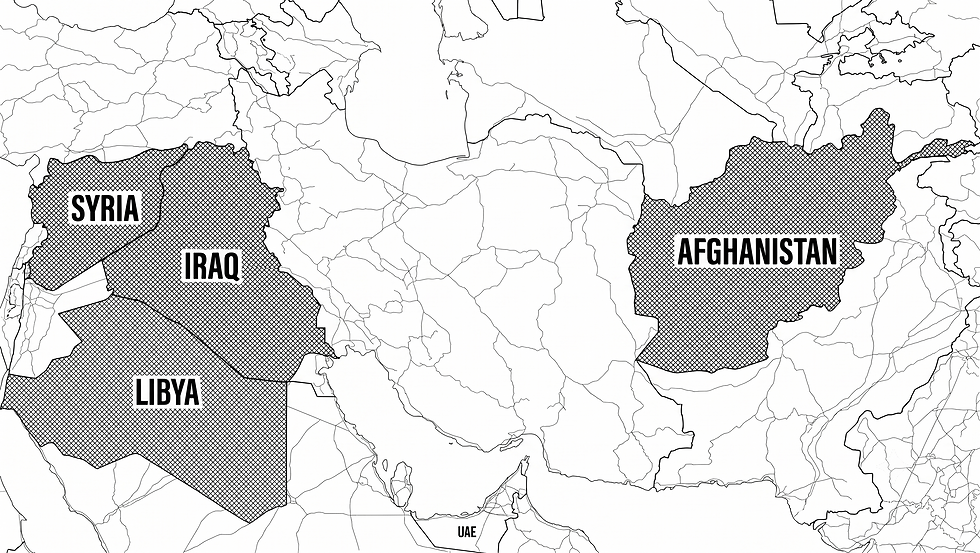
A Map of Good Intentions and Bad Outcomes
Afghanistan (2001–2021): The Taliban were toppled in weeks. What followed was twenty years of trying to build a nation at gunpoint. $2.3 trillion later, the Afghan army, which the U.S. spent two decades training, collapsed in eleven days. The Taliban walked back into Kabul without firing a shot. For the women and girls who spent twenty years building lives, the clock was reset overnight.
Iraq (2003): This was sold on weapons that didn't exist. When the government fell, the decision to dissolve the Iraqi military turned hundreds of thousands of armed, trained men into an unemployed, humiliated opposition. That choice didn't just cause chaos; it literally seeded ISIS. Over 4,400 Americans died, but for Iraqis, the cost was 150,000 to 600,000 lives, and four million people were forced to flee.
Libya (2011): NATO stepped in to stop Gaddafi. Gaddafi was killed. Then everyone just... left. There was no plan for what came next. Libya, once a leader in development for Africa, became a failed state in months. Today, it’s a patchwork of militias and documented open-air slave markets.
Syria & Venezuela: In Syria, half a million people are dead after a decade of a "multi-national" proxy war. In Venezuela, "maximum pressure" and sanctions haven't removed the leadership, but they have forced 7 million people to leave their homes, the largest displacement in Latin American history.
The Neighbours Who Never Had a Choice
When a state collapses, the fallout doesn’t respect borders. Take Jordan. It’s a small country, already short on water. They didn't invade Iraq, and they didn't fund Syrian rebels. Yet they’ve absorbed nearly two million refugees. Schools are overflowing, and 93% of Syrian families there are in debt just trying to survive. Jordan didn't choose the war; they just had the misfortune of living next to a country that someone else decided to "remake."
"It’s easier to bomb a country into regime change than it is to build a life afterward."
Removing the Regime Is the Easy Part
Foreign policy continually falls for the same fatal assumption: remove the dictator, and a functioning society will magically assemble itself. It never does.
Governance cannot be installed at gunpoint. When occupational forces withdraw, institutions built without local legitimacy collapse. Organizations like ISIS did not emerge from a cultural vacuum. They were the direct, documented consequence of administrative choices made in Washington in 2003, specifically the decision to disband state security institutions and leave hundreds of thousands of trained men unemployed.
The Questions Policy Makers Avoid
When international law applies exclusively to the defeated, it ceases to be law. It becomes power politics with better branding.
As millions flee across borders into fragile neighboring states, a critical accountability gap opens up. Who holds the legal obligation to feed and house them? At what point does a catastrophic strategic error become a formal legal liability for the governments that ordered the strikes?
History rarely condemns nations simply for pursuing strategic interests. It condemns them for the chasm between their moral rhetoric and their actions—for championing human rights while destroying civilian infrastructure, and for invoking sovereignty while violating it abroad.
The true cost of forced regime change is never captured in a military budget. It is a compounding debt settled entirely by civilians who were never asked if they wanted to be liberated in the first place.


Comments