Polaris System: Guiding Star of Humanity

Updated: Aug 4
For eons, humanity has looked up to the Stars for guidance, with some stars getting to play a particularly important role in our evolution. No, I am not talking about our Sun, but about Polaris, commonly known as the pole star.
First described as the Cynosura (the pole star) in the fifth century by philosopher Stobaeus. Polaris became the absolute bedrock of global navigation and continues to play a key role in our understanding of the universe. Its navigational importance relies on two main factors: first, it is a moderately bright supergiant isolated in a dim patch of sky, making it easy to locate using the pointer stars of the neighbouring Big Dipper constellation. Second, it happens to sit incredibly close to Earth's true celestial north pole.
While satellite technology and GPS have effectively retired Polaris from its ancient role as Earth’s primary navigator, its true cosmic value is only just beginning to shine. Beyond its identity as the Pole Star, Polaris is the closest and brightest Cepheid variable star to our planet.
To scientists and astronomers, these unique stars act like cosmic streetlights used to calculate the vast distances of space.
What are Cepheid Variable Stars and Why are they important???
A Cepheid variable star is a bright, massive star that pulsates like a beating heart, expanding and contracting in a regular cycle. As it does this, its brightness (luminosity) and temperature change on a highly predictable, rhythmic schedule.
In 1912, astronomer Henrietta Swan Leavitt discovered that the longer a Cepheid takes to complete one pulse cycle, the brighter the star is. This later came to be known as the Period-Luminosity Relation.
In other words, if you time how long it takes a Cepheid to dim and brighten, you can calculate its true brightness and exactly how far away it is. Because the pulse cycles of Cepheid variable stars are rhythmic and predictable, they serve as a cosmic "standard candle" or "cosmic yardstick" for measuring the scale of the universe.
The Polaris System:
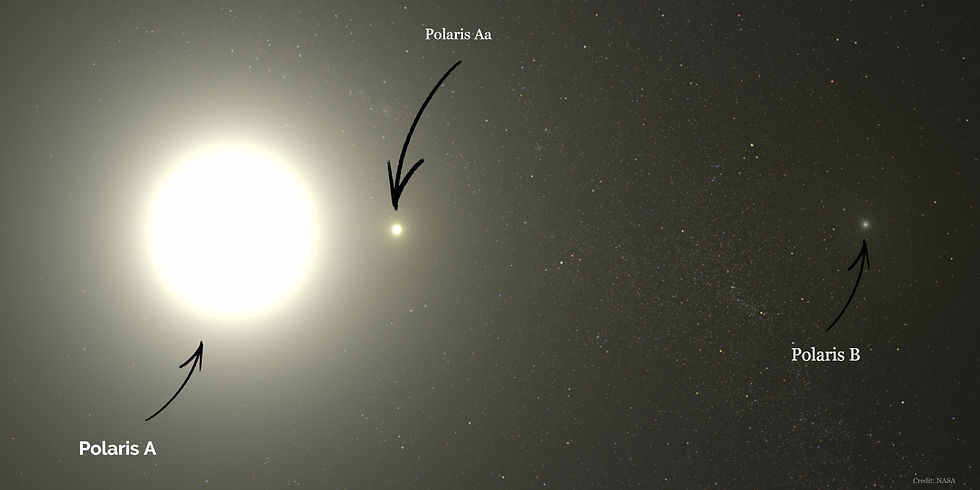
Unlike what most think, Polaris is not a lone star but a system of three stars, among which is Polaris Aa, the Pole Star, the yellow supergiant Cepheid variable we see with the naked eye.
Polaris B, the second largest star in the system, was discovered in August 1779 by astronomer William Herschel. Polaris B sits at an unfathomable distance of 2,400 Astronomical Units (AU) from Polaris Aa. At this distance, it was not swallowed up by the main star's glare.
The third companion, Polaris Ab, a tiny dwarf star orbiting incredibly close to the main supergiant. It was difficult to spot because it was completely drowned out by the sheer brightness of Polaris Aa, with its existence being purely theoretical for over a century.
In 1899, American astronomer William Wallace Campbell noticed weird variations in the radial velocity of Polaris Aa. The main star was seen wobbling, which suggested p the gravitational tug of war with an unseen partner.
It was named Polaris Ab in 1929, after scientists studying the spectrum of light coming from Polaris firmly confirmed that the main star had a tight binary companion. However, it was not until January 2006 that NASA released a historic image from the Hubble Space Telescope, finally isolating the tiny star visually from its companion's glare.
Breaking the Rules:
Polaris System is unique, as most Cepheids are isolated or belong to distant binary pairs where the companion is too far to measure easily. The configuration of stars enables scientists to get more information on Cepheids (Polaris A), how they form, and when they form.
Yet, Polaris A refuses to follow the norms and breaks the rules of how a textbook Cepheid is supposed to behave.
In the early 1900’s, scientists calculated that the brightness of Polaris A fluctuated by about 10% to 12% with a pulse period of approximately 3.97 days (just under 4 days). It was observed that the pulsation amplitude plummeted to less than 1% 1% of its total intrinsic luminosity by the mid-1990s.
Just as astronomers thought that they were watching a Cepheid evolve out of its pulsating phase in real-time. Polaris Aa decided to power up again, and the pulsations started getting stronger in the late 1990s and early 2000s. To date, Polaris Aa is the only Cepheid that has been observed to dampen and brighten its pulses. These behaviours can break the methods we use to measure the scale of the universe. If all Cepheids can do this, they can no longer be used as a "cosmic yardstick."
There is still a lot for us to learn about our galactic neighbourhood. With many more mysteries and questions, we have yet to discover.

Comments